
Buffalo Philharmonic Orchestra in Daytona Beach – A Review by Dana Paul Perna
Comments Off on Buffalo Philharmonic Orchestra in Daytona Beach – A Review by Dana Paul PernaMay 25, 2026 by Admin

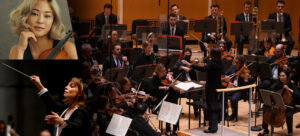
On March 27, 2026. the Buffalo Philharmonic Orchestra, under the baton of their Music Director JoAnn Falletta appeared at the Josephine Field Davidson Theater of the News-Journal Building in Daytona Beach, Florida, marking the final stop on their tour. While they have appeared in that city before, it was their first time appearing in this venue that proved a highly successful one for them. The program featured “Three B’s”, yet, with the exception of Brahms, not the usual “Three B’s” one associates with that initial. In this case, the trio consisted of Butterworth, Bruch and Brahms (…..and there was an encore not written by a person with a “B” as their final initial, but we’ll get to that).
Preceded by an opening address to the audience by Mark Francis, Executive Director of the Daytona Beach Symphony Society welcoming everyone, the concert began with a most delightful idyll On the Banks of Green Willow by the British composer George Butterworth (1885-1916), whose life was cut short due to his service in World War I when he was shot by a sniper, putting an end to one of the most promising composers of his generation. Scored for an orchestra more analogous to that of Haydn + a harp, Butterworth skillfully wove English folk melodies into an eloquent symphonic fabric whereby the lyrics are never missed by the listener. Alas, Butterworth did not live long enough to compose lengthy symphonic works, so even this one – one of his most performed titles that represents English pastoral music at its very best, runs just about six minutes. Despite its poignant brevity, it certainly states everything it needs to poetically impart in a lyrically lush backdrop of the most vibrantly verdant fashion. All of this was clearly captured and conveyed by Buffalo’s forces under Maestra Falletta’s baton, setting the stage for the concerted opus for which Butterworth’s gem served as this concert’s opener.
Next up, and also based on folk materials came the ever-popular Scottish Fantasy for Violin and Orchestra in E-flat major, op. 46 by the German composer Max Bruch (1838 – 1920). While the orchestra is called upon to supply support, in the end, it is a vehicle – a showpiece, in fact – for any soloist who, if not up to the task, there really can’t be much of a performance up for discussion. Cast in four movements, this concerted opus from 1880 remains among the most performed of any of Bruch’s output that he built utilizing Scottish folk melodies. When premiered by Joseph Joachim in Liverpool in 1881, Bruch was unhappy with his interpretation, while the work received a far more successful presentation in 1883 in Poland, when the soloist was Pablo de Sarasate, leading Bruch to dedicate the composition to Sarasate thereafter. Since then, it has become a standard among the concerted literature for violinists internationally. On this concert, Buffalo was joined by violinist, Simone Porter, who assailed the solo part with aplomb most professionally. Hailing from the late Romantic era, given that style, any passage work required of the soloist, such as in the final movement, allows it to be enjoyed at least twice. Ms. Porter did not falter in any such passages, nor any other portion of it for that matter as she was backed, as one would expect, like hand-in-glove by the orchestra, and Maestra Falletta. Tunefully glowing, engaging, at times lyrically flowing, it would have proven hard to disengage from a presentation as fine as this interpretation was.
The audience responded with the appropriate amount of enthusiastic applause that prompted a solo encore from Ms. Porter. While she could have chosen a piece by Bach, keeping the “B” theme going, she, instead, presented a short 21st Century composition. Titled Sabina by Andrew Norman that dates from 2006, she proceeded to assail all attendees with the technical wizardry this 4 minute’s worth of “….walking in the sunlight…” was intended to impart with magnificent integrity.
Following intermission, the concert resumed with Symphony No. 1 in C Minor, op. 68 by Johannes Brahms, the concluding work on this program. Within the canon of the Symphony, this one remains among the top ten greatest in the genre, let alone its place within music from the Romantic Period that it has transcended due to its timelessness. In four movements, it is the most dense of the four Brahms would compose; dense in terms of its expansive structural ingenuity, his use of instrumentation, its harmonic acumen that accompanies his melodic creations, along with a masterly sense of pacing and rhythm.
Completed in 1876 after 21 years worth of effort in fully realizing this to accomplish the Masterwork it remains, one would expect these forces to deliver, at the very least, a good performance of it. Not to slight anything witnessed up to this point, yet this performance ALONE was worth the price of admission. Right from its familiar opening strains, it became obvious to one-and-all that this was not to be your Grandfather’s stuffy, sluggish or stale facsimile of this well admired perennial. Falletta and her Buffalo forces rendered an honest representation that contained moments of great brilliance without having become bombastic while retaining refinement without sterility. Given the history and period in which Brahms completed it, this performance was masterfully driven by appropriately spirited tempi (where applicable!) that served to vibrantly highlight those rhythmic components so often lacking in the interpretation by other conductors. For this reason, the harmonies arrived within their proper proportion and context where, when and HOW they were supposed to. This symphony’s radiant finale brought this entire evening’s worth of music to its formidably luminescent conclusion.

Dana Paul Perna
Category Sound | Tags:
Comments Off on Buffalo Philharmonic Orchestra in Daytona Beach – A Review by Dana Paul Perna
Sorry, comments are closed.

